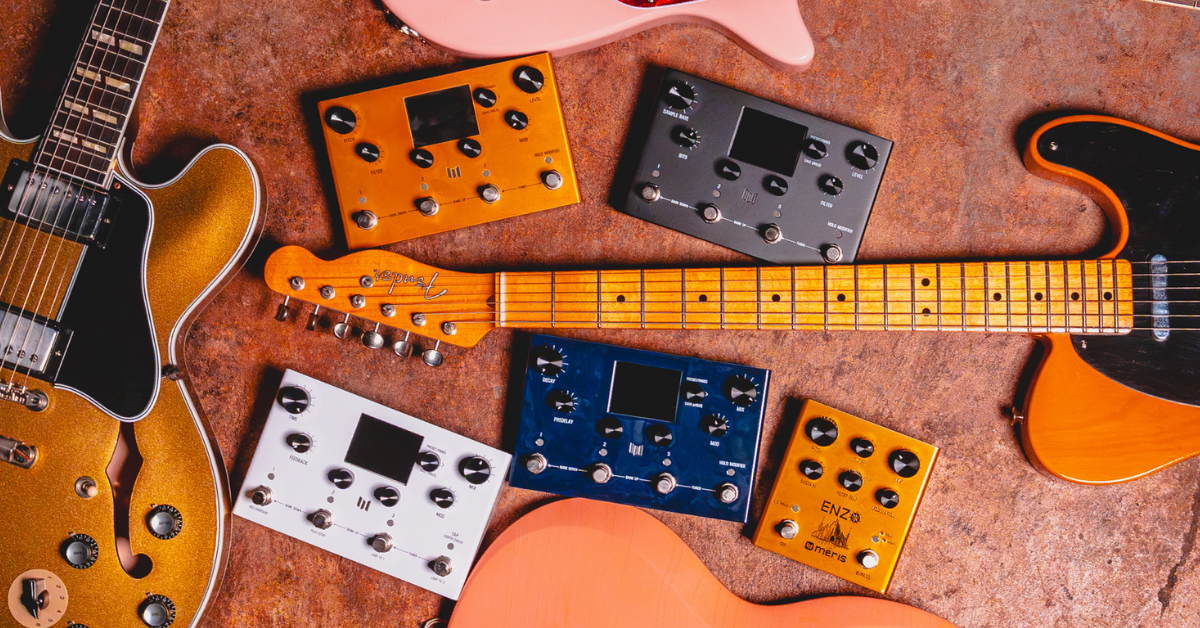
The team at Meris is a close-knit crew dealing in some of the most powerful, dynamic, and musical devices available today. Their latest series of units, including the Mercury X Reverb System, the Enzo X Instrument Synthesizer, and most recently, their Ottobit X '80s Texture Engine, has garnered acclaim for its ultra-modern playability and seemingly endless well of sounds.
We sat down with Meris – founder Terry Burton, creative director Jinna Kim, and DSP engineer Angelo Mazzocco – for a chat all about their premier pedals, Commodore 64 video games, hip-hop turntabling, ‘80s sci-fi, and the limitlessness of art.
Russo Music: Can you introduce yourselves and describe your roles at Meris?
Terry Burton: I do all the electronic hardware engineering. That means coming up with the engineering implementation for the product we want to make, putting together a schematic and then laying out the circuit board.
I also manage the manufacturing end of the business and tag team with Angelo to keep that heavy wheel running as smooth as possible once it’s turning. I try my best to steer the ship on which products we’ll make next, and now after twelve-plus years, our company has progressed to where Angelo, Jinna and I are all able to collaborate on defining the details of what those will end up being.
Angelo Mazzocco: I was lucky enough to start my career as a DSP Engineer at Line 6 where I learned an incredible amount working alongside the founders and engineers who in turn got their start making instruments for Oberheim and Alesis. At Meris, I am so grateful to be able to follow my heart, creating algorithms and designing new sounds.
Jinna Kim: Hi, I’m Jinna, pronounced “Gina.” 😊
I’m the Creative Director here, which means I oversee everything visual at Meris, i.e., branding, video production, website design, photography, UI/UX (large boxes), graphic design, art, etc.

The Ottobit X covers a lot of ground when it comes to lo-fi and glitch effects. What drove you to expand the usual pool of "lo-fi" effects to include hip-hop record scratches, VHS static, and other things you don't usually first associate with lo-fi, guitar-forward effects?
Burton: First of all, Angelo makes all of this genius DSP code come to life. We wouldn’t be able to do any of it without him. Jinna wanted the Wikki Wikki FOREVER. It has been in prototype in some form for probably six years. I had the seed of an idea to reimagine what delays and reverbs would sound like if they were made of a huge impractical array of the VHS machines that we grew up with as kids and Angelo ran with that and made it incredible.
Mazzocco: Wikki Wikki was born out of Jinna’s love of hip hop and the VHS vision came from Terry. I went down the rabbit hole of slicing up chunks of time and volume all sorts of different ways. It is easy to see all three of us in Ottobit X and I love that combination. It shows up in everything we do.
The Ottobit Jr. refers to the sound of arcade cabinets and early video game consoles. In the process of designing the Ottobit X, were there any choice video games on your minds that proved impactful or inspirational to the pedal?
Burton: I grew up with a Commodore 64 so the sound of the SID chip soundtracks to all of those C64 8-bit games are well etched into my memory. Skate or Die, California Games, Maniac Mansion, and Below the Root are some that I remember. The way composers arpeggiated with the SID was a big influence on Ottobit Jr. and now Ottobit X.
Mazzocco: Absolutely! Those early gaming experiences had such great audio cues that became cultural reference points that everyone can identify. From golden-era NAMCO games, to Commodore 64, to NES, to Genesis, those systems were all backed by such talented musicians and designers who made unforgettable sounds.
What inspired you to loop in artists for their own presets on the Enzo X and Ottobit X, and what drove you to call on names like Yvette Young for such presets?
Burton: We're lucky enough to call them friends.
Mazzocco: Hearing an artist we love take the palette that we designed and make it their own is an amazing full circle moment. We strive to make our pedals instruments and extensions of the player, so hearing artists we respect combine our pedals into that very personal creative space is both humbling and satisfying. Seeing Yvette using the Mercury7 on her iconic soundtrack work stands out as one of those moments.
The Ottobit X's preset effect bank features references to famous '80s directors like Ridley Scott and David Cronenberg. Do you each have an '80s movie you'd say was inspirational to the Ottobit X in any way, and why might it be inspirational?
Burton: TRON for me, and just in general the feeling of riding your bike in the '80s to the video store and picking out a movie on VHS, a lot of times just because of the cover. Blade Runner has been a continuous inspiration for us. Sometimes, the way I like to create presets is to start with a name and work backwards from there, which is what I did with Cronenberg-esque presets like “Videodrome” or “Scanners.”
Mazzocco: I want to add Paul Verhoeven to that list. During that era, he and his team used music and sound design to convey satire, humor, and pain, usually all at the same time. Triggering a complex emotional response with sound is definitely inspirational and something I aim for.
Jinna, you've stated about the Ottobit X, "'Wikki Wikki' is the only effect I ever asked for... The real-time vinyl scratching, break and back spin while looping is crazy fun." Now that you have it in the Ottobit X, do you now have a second effect you might be hoping is on the horizon?
Kim: Yes, that’s correct. Wikki Wikki is the only effect I asked for (and named), ever, in eleven years with Meris. Back in 2020, while working remotely during COVID lockdown, I casually asked Angelo if vinyl scratching was possible in a pedal format. Months later, Angelo surprised me with a video of him utilizing Ottobit Jr. as temporary housing to test scratch using a tiny sample. It made me giddy. Five years later, we were ready to develop an expanded version of Ottobit Jr. to be Ottobit X today. Since Ottobit X ended up having a sixty second looper, it was important to me that the scratching was in real-time, not simply emulating just random scratching sounds, but scratching from any recorded loop.
That’s when Angelo looked challenged (laughs). Wikki Wikki ended up being one of the most challenging thing Angelo had to work on in Ottobit X, only because it was an unprecedented sonic ideation, “I know it’s silly, but I really want it”, I said.
Because I never asked for any effects in the history of Meris, Angelo was sincerely devoted to make do. I felt bad because I was really picky with the sound, the physics of how a hand would stop vinyl, scratch and/or play again, but on the contrary, Angelo added break and back spin on his own! I was so excited when he demonstrated it to me. I don’t think I’ll have the audacity to ask for another effect again. Angelo is way too good for my silly ideas, but I think it’s fun!
"Art and sound are unlimited, so there is no shortage in the types of algorithms and tools that we want to bring to people. Since we are perfectionists, finding the time to chase all our dreams is the bigger challenge." - Angelo Mazzocco, Meris DSP Engineer
Many Meris pedals are driven by nostalgic inspirations including visual art and movies. In that same kind of world, what's maybe a more contemporary influence that you could point to as impactful to Meris pedals?
Burton: I would say that it’s what music we’re listening to at the moment. The current new bands I’m constantly on the search for are either directly or subconsciously influential. I also always feel inspired after visiting an art museum or exhibit. We recently got to visit the Art Institute Museum of Chicago (the one in Ferris Bueller) and that triggered lots of synapses.
Mazzocco: The contemporaries that first come to mind are not traditional visual artists, although there is a visual component to what they do. I have to mention Squarepusher and Aphex Twin, their manipulation of time and how they each use metric modulation in their own way definitely influenced Ottobit X.
The last original Meris pedal left without an "X" version is the Hedra. Hypothetically, what might an "X"-version Hedra look like?
Burton: Always possible, although we may have other tricks up our sleeves as well.
Mazzocco: Whoa, were you the kid who tried to figure out their Christmas presents early? You can count on everything we do to be ambitious and unexpected.
With so many effects in each Meris "X" pedal, you've clearly accounted for many musical possibilities. Have you ever been surprised by the sounds Meris fans have created, in a way you didn't consider when designing the pedal originally?
Burton: That's one of the most gratifying parts of designing an effect is hearing it used in a way you could have never played with your own hands. It was our vision from the beginning to create effects that act as instruments and let you make sounds that you couldn’t otherwise.
Mazzocco: It is always so fun hearing what people come up with. Designing sounds and making music is such a personal experience, listening to how each musician reacts to what we made and melds it with their own creative vision is the best. When it comes to sharing sounds, Jinna did such a great job integrating Patch Storage into prEDITOR. It is so easy now to post your presets publicly and try out what everyone is working on without ever leaving prEDITOR.
Your “X”-version pedals have gained plenty of praise with their upgrades and playability, though there’s surely still love for the stompboxes from which they originated. Do you each have a favorite of the original five Meris pedals?
Burton: Polymoon is my favorite out of the five. It’s one of those you can just sit down with and come up with new ideas for hours.
Mazzocco: I still use them all the time! I always say that it's hard to pick my favorite, and it's true that they're all my favorites, but out of those five I am currently using Mercury7 the most. In my stereo amp setup, Mercury7 is my “always on” pedal. I also want to highlight our 440 preamp that Terry knocked out of the park. I’ve used my pair of 440s every single day for over ten years. Whether it is using them as a DI, a re-amper or lush preamp, they are easily my most used Meris device.
Is there any possibility those pedals’ style of more compact, singular effect experiences might someday be revisited?
Mazzocco: Nothing is ever off the table, we have so many ideas for so many form factors!
When approaching new device designs, how do you come up with new effects and sounds to tackle, with Meris pedals already having covered so much ground?
Burton: This is one of the unintended side effects of starting a project from a conceptual standpoint rather than a general idea. I find that it inspires way more outside of the box thinking and creativity during development. For Ottobit X we expanded the concept beyond video games and brought in all kinds of ‘80s nostalgia which made the world and possibilities much larger and more exciting.
Mazzocco: That's an easy one. Art and sound are unlimited, so there is no shortage in the types of algorithms and tools that we want to bring to people. Since we are perfectionists, finding the time to chase all our dreams is the bigger challenge.
What keeps you pushing for the next big thing that excites you?
Burton: Luckily, we’ve always had more ideas than we had time to make them all come to life, so we choose carefully what we’re going to dedicate time to. We are a very small team so focusing really intently on one project at a time is the norm.
Mazzocco: Purely the love of sound; music, instruments, art, engineering... all of it. I feel incredibly grateful to be able to design and build the algorithms I've always dreamed of creating, and I get to do it alongside talented, funny partners I respect immensely! That's what keeps me excited.
What’s next for Meris?
Kim: I’m confident to speak for us all, that we hope to have the opportunity to surprise everyone, in a good way. :-)