Be kind, rewind!
Oh, tape. Humble, humble tape. For as long as there's been recorded sound, there's been tape (don't look it up, just go with it). Grab some tape for your cassette recorder, your Space Echo, your analog overdrive... wait, what?
That's right. For so long, the charming character of a saturated tape reel has been one of overdrive fiends' favorite obscure dirt textures. Far less prevalent than your transistor, chip, and gain stage drives, tape saturation has been here the whole time, but never assuming center stage – and what a shame, right? From Petaluma, California's finest in effects, a new all-analog creation rushes tape saturation out to the spotlight and invites it to take a bow. Let's talk about it.
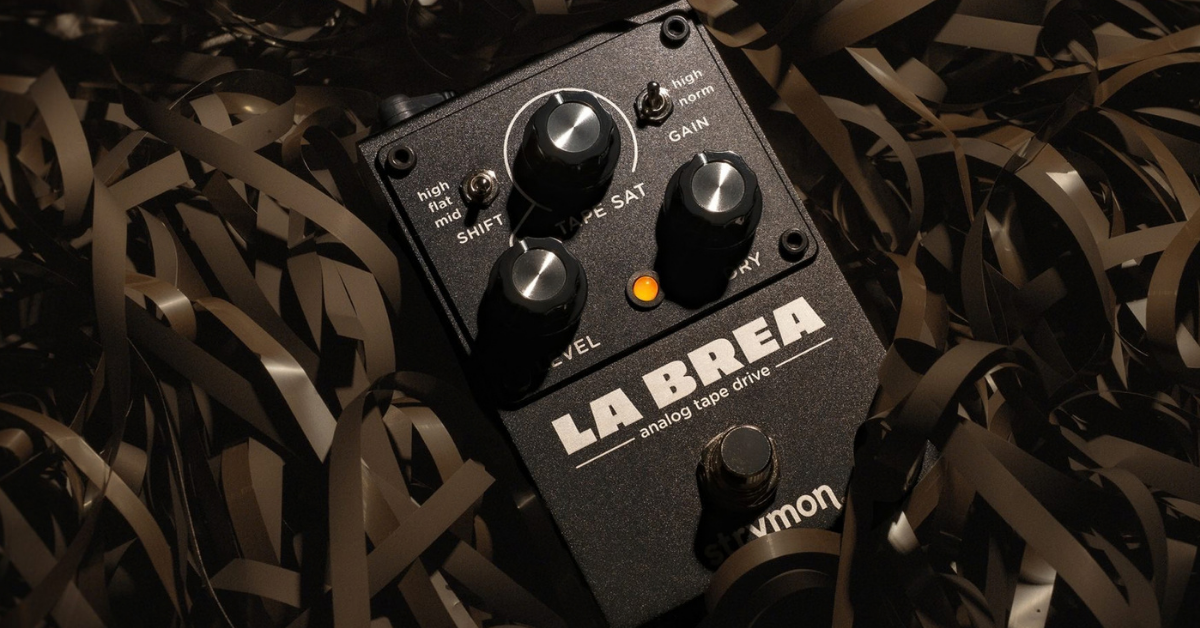
This is the Strymon La Brea Analog Tape Drive.
Brea On Through (To the Other Side)
Introducing the Strymon La Brea Analog Tape Drive
It seems like it's never too long before we're back talking about Strymon and their latest unignorable effect innovation. Just this year we've already talked about their upgraded TimeLine MX Multi-Delay and their Canoga Vintage Silicon Fuzz. Both striking additions to the Strymon line – one a follow-up on a Strymon classic and the other a fresh entry – had quite a bit to talk about. The latter of the two, the Canoga, assumed a spot among Strymon's Series A line. This relatively new series from Strymon breaks the mold on their reputation for exclusively digital effects. In their "Series A" line, Strymon gives the keys to their dedicated analog team for fully analog creations as clean and powerful as their digital classics.
The La Brea is the latest in Strymon's Series A catalog. This clean, black box homes in on a different persuasion of analog drive effect. Where past creations like the Canoga and Fairfax focused on classic fuzz box formulas and amp-forward overdrive methods, the La Brea takes a different route. Taking cues from the Deco tape doubletracker and saturation – a bona fide Strymon classic – the La Brea explores tape-style saturation as a means for drive, distortion, and even fuzz. Fully analog design paired with unique control angles makes for an exciting dive taking tape saturation truly where it's never been before. Stick around.

The Everlasting Tape
Strymon La Brea Analog Tape Drive Design and Controls
Those holding out for a dedicated tape-style drive* have had their prayers answered with the La Brea. Not to get ahead of ourselves, but fans of tape-style saturation, unique drives, and off-the-wall distorted signal flows have something new on their list to check out with the La Brea. The pedal lays out simply with three control dials and two switches. Let's talk about these controls a little more granularly and what they mean for the overall tape-style soup we're cooking up.
Or even just a follow-up to the beloved Deco
Strymon La Brea Analog Tape Drive Controls
- Level – The volume of our tape saturation. Clockwise for more, counter for less. Easy, right? Perhaps something to mention is that, while tape saturation has usually been the realm of more unassuming, textural drives, the La Brea has quite a bit of volume on tap to play with. This will come up more a little later.
- Tape Saturation – The amount of distortion in our tape saturation. Clockwise for more, counter for less. Starting humbly and unassumingly and quickly bumping up to pretty mean and dirty levels, here's where you'll see the La Brea is a pedal to put some hair on your chest.
- Dry – The balance of tape saturated wet signal and unaffected dry signal. Here's probably the control that puts the La Brea over the edge in terms of uniqueness and innovation. A dry signal control introduces a pretty foundational element of playability where the pedal's saturated textures can either stand center stage or be inched in incrementally to play alongside other effects or driven amps.
- Gain – A two-way selection switch between default "Normal" gain levels and "High" gain levels. Bump up the La Brea's Gain to "High" and pretty much immediately you'll get a helping of the kick we're working with here.
- Shift – A three-way high-end frequency boost. Meant to assist in its punch and articulation, the La Brea's top-end can get two bumps up or kept at flat.
Should I Brea or Should I Go
Strymon La Brea Analog Tape Drive Design and Controls
With the La Brea, we're working with a pretty simple pedal with a surprisingly deep musical experience to explore. What's more, the expansiveness of the experience is easily apparent before long. Grab hold of the La Brea, start twisting some knobs and you're sure to come up with some devilish ideas.
Get It on TapeStarting out slow, we can take a trip down a familiar lane for our tape saturation. Keep your Level and Tape Saturation levels and your dry signal zeroed out to enjoy a classic tape saturation drive. Dig into the effect's natural touch responsiveness for some smooth, velvety dirt and thickness, as you would with a punched-up Deco saturation level. The La Brea offers an elevated level of control over the Deco, so those looking to get a deeper dive into tape saturation have found sanctuary with the La Brea.
Para Bailar La BreaOf course, that's not all we're working with with the La Brea. Part of what's so enthralling about the effect is its mettle as a full-blown distortion. Things get loud before long as you punch up the pedal's Tape Saturation and Level controls. Past noon on Tape Saturation, the La Brea gets pretty heated with more gain and dirt to shake a stick at. Plenty of sustain makes the La Brea perform admirably as a distortion (or even fuzz) for accentuating solos with a controlled burn of drive. Raising the stakes with bumped-up top-end Shift settings puts the La Brea well into consideration for your sole distortion engine.
C'est La Vie La BreaProbably the thing that truly makes the La Brea unique and worth checking out, since we haven't talked about it enough already, is its dry signal mix control. For some, this will surely be the showstopper. Use the dry mix control to allow more space for your other sounds in the signal – and then from there experiment with the Level and Tape Saturation to make a pseudo-parallel-dry-wet blend where the La Brea plays a supporting role to your other sounds. Pump up the dirt on the La Brea and slip it into a supporting role by making your dry signal more present. Create captivating undercurrents of breakup, balance tape-style fuzzes with an already broken-up amp, play with greater articulation with a balance of clean and dirt, whatever you're into!
Strymon La Brea Analog Tape Drive Final Thoughts
Alright, so where are we at?
With the La Brea, Strymon in their Series A line of all-analog effects drafts another winner. This compact, fully analog drive pedal takes on retro-style tape saturation tones in an all-new fashion with a couple of angles of attack to attempt even if you're not already in-the-know on tape saturation. Truly unique playability – especially when factoring in the pedal's analog design – through dry signal mixing, level balancing, and distortion melding makes the La Brea perform vividly. Highly musical textures permeate throughout the La Brea to give lifelong tape saturation fans a field day and unconventional distortion devotees something to really chew on.
Maybe you first got into Strymon effects through their Deco. Maybe that pedal's tape saturation effect side stuck with you. Maybe you've been chasing that wonderfully warm and chunky dirt ever since. You certainly didn't need to get this far to know that the La Brea is for you. For anyone else, welcome in to the wonderful world of tape saturation. Stick around a while – evidently it'll be some time before we reach this tape's end.